
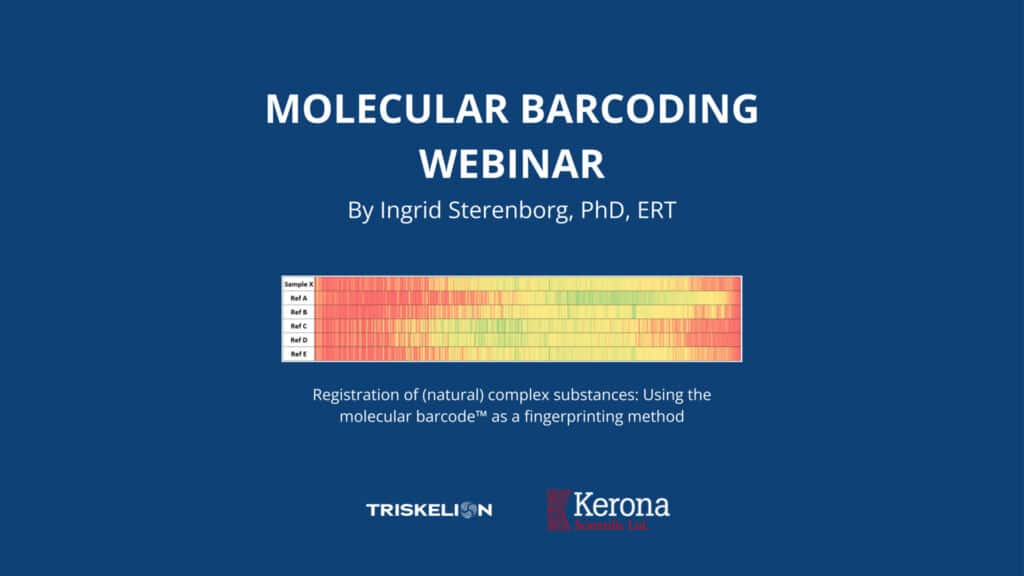
During the Dublin Plant Protection Symposium, Triskelion’s Ingrid Sterenborg, PhD, ERT gave the presentation on how to use the molecular barcode™ as a fingerprinting method. Ingrid educates on the ongoing shift from the use of traditional active substances in plant protection products to biological active substances, such as botanicals, semiochemicals and peptides.
Most of these biologically active substances are natural complex substances, with a variable or unknown composition. The guidance refers to the use of chemical fingerprinting, but does not explain how this should be performed. Triskelion developed the molecular barcode, based on non-targeted LC-MS, that can be used as a tool to provide an initial overview of the identity of (natural) complex substances. In addition, the molecular barcode is a suitable tool for assessing similarity of natural, complex mixtures and can therefore be used for 5-batch analysis.
For preparation of the dossier for natural complex substances, a tailor-made approach should be followed. Information may already be available due to the use of the substance in other areas (food, medicine, biocides, etc.), or because man and/or the environment is exposed to natural background levels. For substances that may contain components that are of possible concern for humans and/or the environment, a combination of information from the components and studies with the complex substance may be needed. Therefore it is advised to prepare a registration strategy based on available knowledge and discuss this with the RMS in a pre-submission meeting.